
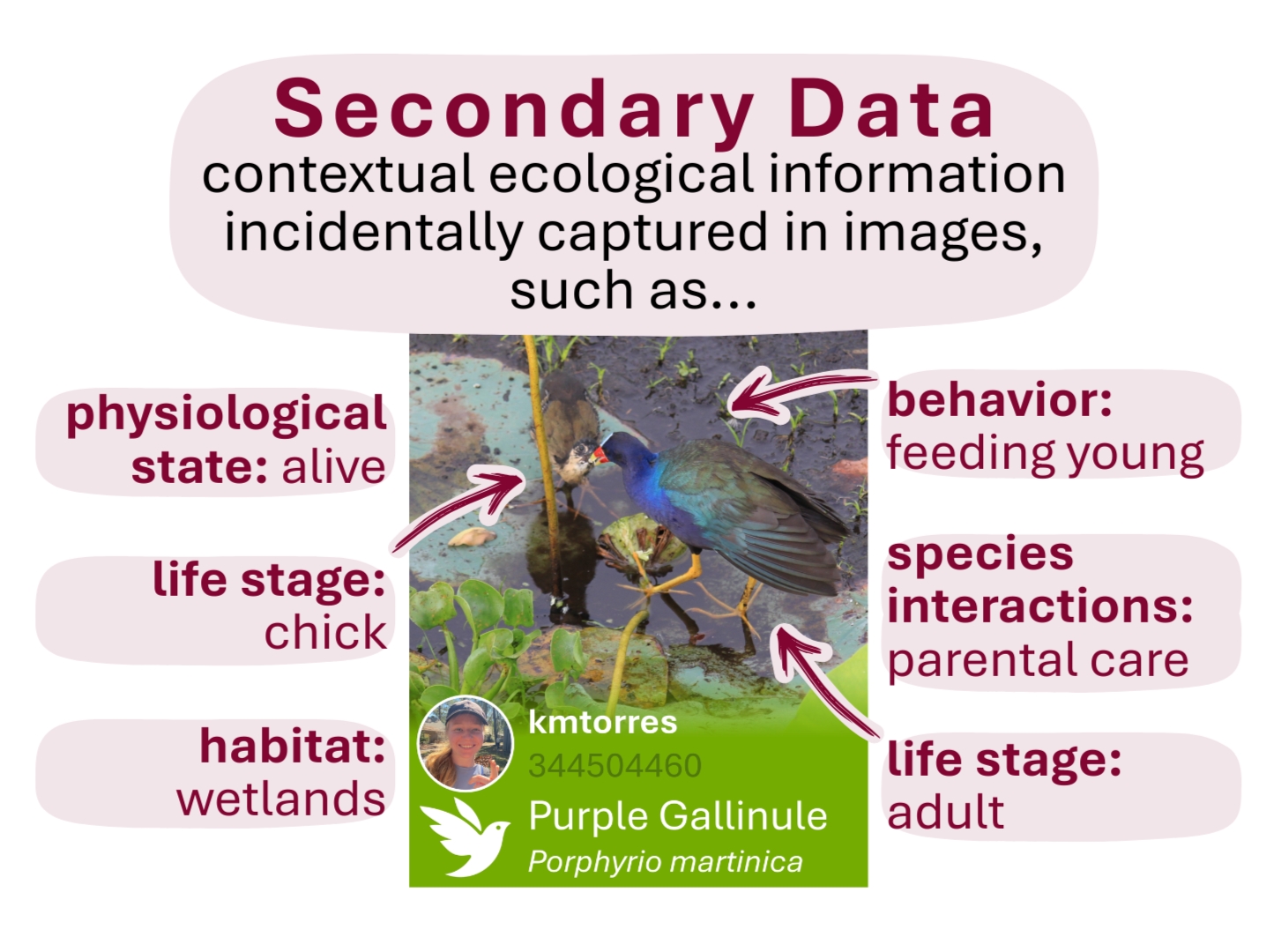
Digital images are untapped sources of ecological discovery. Beyond confirming the presence of a species, images incidentally contain contextual ecological information, such as habitat, species interactions, physiological state, phenology, morphology, ontogeny, and sex. Extracting this secondary data allows researchers to study fine-scale ecological and events from any physical observation.
As of 2026, the participatory science platform iNaturalist has amassed over 181.1 million “research-grade” observations representing over 457,219 species. Scientists widely utilize these observations to track species range expansions, study climate-induced phenological shifts, and document new species discoveries. Because these observations are supported by digital images as proof of organism evidence, there is potential to explore the indirect applications of image-derived secondary data, yet this frontier remains largely unexplored.
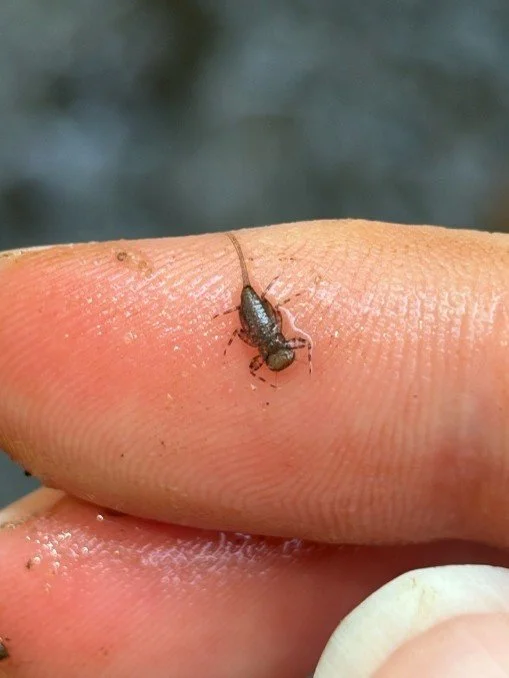
Led by Karina Torres, we are exploring new ways to apply secondary data for ecological research. Using aquatic macroinvertebrates as a model taxon, we demonstrate how secondary data from iNaturalist images can:
1. Enrich occurrence records while increasing data availability for understudied, non-charismatic taxa. Check out our dataset explorer on GitHub.
2. Capture observer behaviors and sampling techniques within unstructured participatory science datasets
3. Reveal spatial selection biases that influence species distribution modelling.